Edge 60, p.1
Edge 60, page 1


The Home of Great
Western Fiction!
Even if a man like Edge felt like settling down, the two-street community of Ross, Oregon was not the place.
Once a gold town, till the lode was worked out, now a lumber town, but only till the timber was cut down, it was a wretched huddle of uncared-for shacks.
Nor was the meal of half-cold bacon and beans he’d just struggled through likely to let him settle for even one good night’s sleep. In fact the only issue settled was that the owner of the Golden Eagle Saloon couldn’t cook.
But most unsettling of all was the half-breed woman. Tall and flauntingly good-looking, Edge had seen her change hands in a poker game. Saw her look of resigned contempt when she went off with her new owners. Had even then an inkling that she was about to have a violently disturbing effect on his life in the near future ...
EDGE 60: THE BREED WOMAN
By George G. Gilman
First published by New English Library in 1989
Copyright ©1989, 2023 by George G. Gilman
First Electronic Edition: November 2023
Names, characters and incidents in this book are fictional, and any resemblance to actual events, locales, organizations, or persons living or dead is purely coincidental.
You may not copy, store, distribute, transmit, reproduce or otherwise make available this publication (or any part of it) in any form, or by means (electronic, digital, optical, photocopying, recording or otherwise), without the prior written permission of the publisher. Any person who does any unauthorized act in relation to this publication may be liable to criminal prosecution and civil claims for damages.
This is a Piccadilly Publishing Book
Published by arrangement with the author’s estate.
Series Editor: Ben Bridges
Text © Piccadilly Publishing
Visit www.piccadillypublishing.org to read more about our books.
For I. L.
who regularly provides the stake.
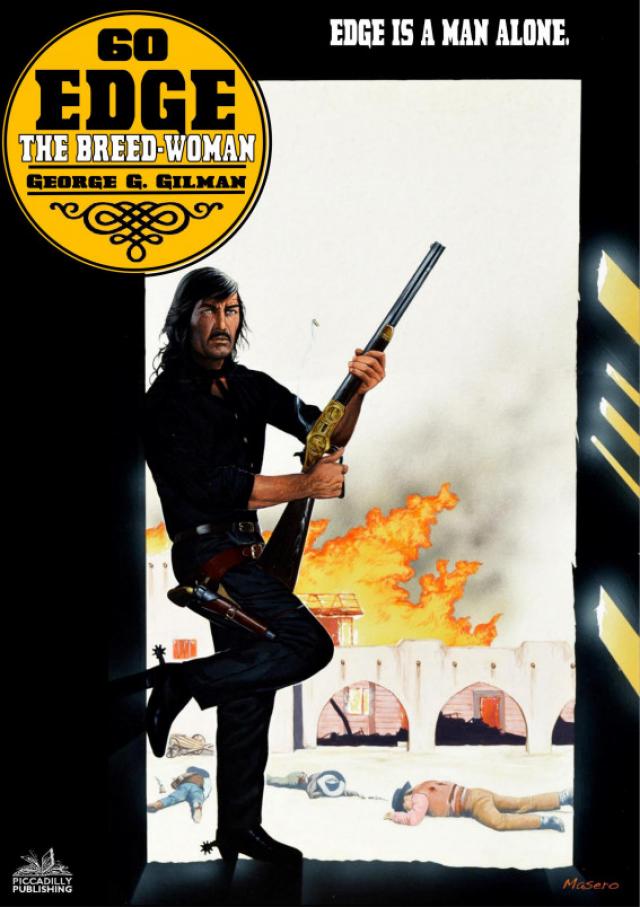
Illustration by Tony Masero
Chapter One
THE BEANS WERE hard, half cooked and on the cool side. And the bacon was tough and stringy, off a hog that had lived longer than the average for its kind. But the beer served up in the saloon was the best Edge had tasted for many miles. So he figured he did not have much cause for complaint in a place like the Golden Eagle, and he did not complain.
Supper was more in keeping with his surroundings than the beer. The Golden Eagle was a pretty good match for the town of which it was a part.
Ross was a small two-street community on a gentle slope in the foothills of the Klamath Mountains in south western Oregon, north of the California line. Gold Rush country thirty years earlier, but timber land now. The gold had not lasted long enough for Ross ever to be a boom town and those few grubbers who got lucky had either frittered away their newfound wealth on transitory pleasures or hogged it and moved on. The wealth which was spent in Ross had not been used to make the town a better place in which to live.
More recently the timber company owners and their workers now made up the majority of the town’s population; but they, likewise, were not inclined to take any pride in Ross.
Which Edge thought he could understand. Because some day pretty soon, the timber in the vicinity would all be felled and there would be no need of a town here. Be it beautiful to look at or just a huddle of crudely-built, worse-for-wear shacks of varying sizes where a man, woman or family could eat, sleep and shelter from the worst of the north country weather and purchase the essentials of life or a few scant luxuries.
As Edge neared the end of the supper that eased his hunger but gave him no pleasure, he found himself reflecting that the stock-in-trade of the Golden Eagle Saloon was probably not considered a luxury in a town like Ross. That at the end of the day, a working man around here felt a compelling need to take a drink before he bedded down. To erase from his mind the knowledge that his existence was comprised so largely of work for work’s sake. A man with sufficient alcohol inside him might be able to blot out what had taken place during the day just over, sink into a deep sleep and gather strength for the next day’s work. Instead of tossing and turning, restlessly awake during the night hours while he wondered just what the hell he was doing with his life.
‘You ate it all up?’ Paul Calhern said.
When Edge looked around at the man who interrupted his train of dark thoughts, he saw an expression close to incredulity on the darkly-bristled, prominently-jowled face of the owner of the Golden Eagle Saloon; five and a half feet tall, more than two hundred pounds in weight, and forty years old.
‘Uh?’ the half-breed grunted, and as soon as the implied query was out the substance of what the fat man had said registered in his mind.
‘It surprises me you ate it all.’
The leather-aproned Calhern picked up the empty plate in one big and soft, unclean hand and the eating implements in the other as the expression of his square-shaped face with small eyes and fleshy lips altered to doleful disinterest. Which was how the saloon keeper usually viewed the world between brief intervals of pretended interest in the subject of any brief exchanges in which he took a part.
It was just an hour ago that Edge became the fifth customer in the saloon. And in that time had learned from Calhern, without asking, the potted history of Ross: seen enough of the man to decide he was at one with his place and the town. Disenchanted and apathetic, but prepared to go through the motions of acting friendly if there was material gain to be made out of the effort.
‘I was hungry,’ Edge told him, delved into a shirt pocket for the makings.
‘That’ll do it,’ Calhern allowed and looked down at the empty plate. Then he shook his head, not in disbelief this time: more like somebody who regrets the pain he has accidentally caused another. ‘I told you the wife, who usually does the cookin’, is—’
‘She’s visiting with her sick mother in Medford,’ Edge broke in on the excuse as the batwing doors swung open and a man entered. ‘You don’t do the cooking as a general rule, but you did your best and—’
His voice trailed away when he saw that the saloon keeper had lost interest in this subject they had already covered: then turned and waddled over to go behind his bar counter as the newcomer responded without enthusiasm to the greetings offered by three of the four men who played poker in a rear corner.
‘Hiya, Eddie. You want your usual, I guess?’ There was enforced cheerfulness in Calhern’s tone which did not completely mask the fat man’s uneasiness.
‘Don’t I always?’ Eddie answered sourly. ‘Which is why it’s my friggin’ usual, right?’
‘Sure thing, Eddie.’
Calhern clattered the plate down, then dropped the cutlery to the floor in his hurry to serve the man. Who was in his mid-thirties, tall and powerfully built with a bushy black mustache that looked like it was carefully shaped to emphasize the implied toughness of his jutting jaw and deep-set, brooding eyes.
Eddie, who was dressed in denim pants held up by an ornately buckled belt and a garishly checked shirt, stood with his flat belly pressed up against the counter, hands splayed on the top, his back to the room until Calhern delivered a glass of beer and a shot of rye to him. Then he grasped a glass in each gnarled hand, threw the whiskey down in one and took a swallow that sank half the beer. Next he put the empty shot glass down on the counter, nodded for the waiting Calhern to refill it, and belched loudly.
All of this was done with a kind of studied intent that suggested that he was engaged in a ritual that never varied from night to night as soon as he entered the Golden Eagle. Likewise, there was a stilted, over-rehearsed quality about the way he finished the beer, placed this empty glass down on the bar for Calhern to refill, then turned to rake a scornful and almost insolent stare over the small saloon with two of its half dozen tables occupied, in opposite corners of the room.
Three of the four card players met his contemptuous gaze fleetingly and looked away. Edge, carefully rolling a cigarette, returned the man’s attention with an equal degree of frost: which caused Eddie to twist his mouthline into a more pronounced scowl before he ran the back of a hand across his mustache, wiped off beer foam.
‘Ain’t nothin’ much in tonight?’ Eddie said as he turned to belly up to the bar again. And timed a pause to let the words add up to an insult if that was how anybody chose to hear them, before he added: ‘In the way of business for you?’
‘There are the two passin’-through strangers, Eddie,’ Calhern replied as he delivered the refilled beer glass. ‘Makes it a kinda unusual evenin’, I guess.’
‘Whoopee!’ Eddie growled in a parody of how the expression was supposed to sound. ‘Two strangers breeze into Ross and we’re meant to figure that’s somethin’ to celebrate.’ Calhern shrugged his fleshy shoulders and stooped to pick up the fallen knife and fork, took them with the dirty plate to the far end of counter where there was a basin of water.
The card game continued in the same quiet way as it had been played since Edge came into the Golden Eagle.
The half-breed struck a match on the underside of the table, lit his cigarette.
Eddie remained facing the bar, the glass of rye in one hand, beer in the other. Stood as rigid as a statue for a few moments, then began to drink in the same deliberate way he had done everything since he entered the saloon. First he sipped the whiskey, then took a larger swallow of the beer: left an unvarying interval of about ten seconds between each double drink.
Edge figured him for the local blowhard bully who might or might not raise a little hell, depending on what kind of day it had been for him and how the booze settled in his stomach. He arrived at this decision in the same way he had catalogued so much else about the town, the saloon and the men in here when he entered: as a mental exercise to keep his mind occupied, unable to dwell on other lines of thought that had no appeal for him but were irritatingly insistent.
In fact, it did not matter what kind of town this was. So long as it had a place where he could get something to eat and a glass of good beer, maybe a shot or two of whiskey that would not take the skin off the inside of his throat on the way down. Somewhere to bed down for the night. A livery where he could arrange for feed and water and shelter for his horse ...
Though it did not really matter if there were none of these requirements in Ross, for he was either self-sufficient or the lush Oregon country could provide what he lacked if need be.
But, after a long ride of several weeks out of winter and into spring over the Cascade Mountains he felt a few of the creature comforts would not come amiss. So he was pleased to discover the Washington Livery Stable and the Grogan boarding house were both adequate for his purpose. Likewise the saloon. And Joel Washington, the Grogans and Paul Calhern were reasonably eager to provide for the requirements of this hard-looking but quiet-talking man who was the second stranger to come to Ross today.
The first was named Vincent Mitchell, sent to the Golden Eagle by Maud Grogan, now one of the players in the poker game that was underway when Edge entered the saloon. Mrs. Grogan cooked breakfast for her roomers, but no other meals. That was the province of the Calherns: although Peggy Calhern was off visiting her sick mother in Medford and Mrs. Grogan could not speak for the cooking skills of her husband.
While Edge had sipped a first glass of the good beer and waited to find out what kind of cook Paul Calhern was, he watched the poker game: ignored by all four players after three of them had greeted him, one of them invited him to take a hand. Vincent Mitchell, whose stylish mode of dress marked him out as the stranger among the others in their hard-wearing working clothes, had not offered a greeting to the half-breed.
And outside of the laconic monosyllables that are all a poker player needs to voice, he spoke just once within Edge’s hearing: a sour-toned objection to the invitation after the half-breed declined to take a chair at the table.
‘Four is fine for five card draw. Five is one too many, so it ain’t. Nothing personal, mister?’
Edge had nodded he did not take the objection personally, then had begun his indifferent watch on the game across the room while he sipped the beer, waited for the food to be cooked and managed to cure his hunger with it.
And pondered his present surroundings, the people who gave it whatever kind of life it had. Which train of thought was little more edifying but a whole lot less irritating than notions about the kind of life he had chosen to live, and where it had gotten him!
First there was the dour-faced but eager-to-please liveryman, Joel Washington, ‘just like the first president, mister, but my folks never claimed no direct line from good old George’. Then the garrulous Maud Grogan and her agitated husband Ray, who did a lot of wan smiling and bobbed his head a great deal, spoke fast whenever he talked like he was anxious to get said what he needed to before his wife cut him off in mid-flow.
The mostly unsmiling people he saw on the streets when he rode into this unprepossessing town of a couple of hundred citizens, walked between the livery and the boarding house, the boarding house and the saloon: some of whom were too preoccupied to notice him, a few who nodded curtly or even offered a terse greeting, most who pointedly ignored him.
Then Paul Calhern, who knew the secrets of keeping beer in fine condition but could not cook worth a damn. The three local lumber company men—either retired clerks or on light duty suitable to their age, he guessed—who accepted Edge’s presence in Ross with equanimity.
Vincent Mitchell who seemed to be the kind of inveterate gambler who cared for nothing outside the game which presently engaged his attention. Had strong feelings only about the ground rules of such a game, one of which held there should be no more than four players in the game. Thus, Edge decided as he dropped the cigarette butt to the floor, crushed out its glowing embers under a boot heel, if one of the other players withdrew, Mitchell would have no objection to Edge replacing him.
Or the sour-tempered, taciturn Eddie who continued to stand at the bar, gazing into space and drinking beer and whiskey with unvarying intervals between. Of the people Edge had come across since he rode into Ross, Eddie was the odd man out. And yet paradoxically, he was more like the kind the half-breed would have thought would be in the majority in this grim timber town. Hard, narrow minded and not kindly disposed to strangers—especially the kind of stranger that Edge was.
Because Edge was himself hard, suspicious of strangers and ... well, maybe he wasn’t narrow minded, but he had certainly gotten to nurture some fixed ideas lately! Like the way, damnit, he elected to spend his life among strangers he viewed with mistrust as he drifted from one frontier town to another, striving never to ride the same trail twice.
But it was getting time to change!
He was pushing fifty, which showed with every line engraved by time and experience into his leather-textured face, along with the world-weary expression of impassivity that seldom left the features shaded and shaped by the mixed parentage of a Scandinavian mother and a Mexican father.
The skin was deeply burnished, although outdoor living had shaded it darker than Latin heritage had colored it at the outset. The black coloration of his hair, streaked with gray now, which hung long enough to brush his shoulders, and the basic bone structure of his face also came from his father’s side.
The predominant physical feature drawn from his mother were his eyes: pale blue and permanently narrowed, which surveyed his surroundings with a brooding coolness that implied total lack of interest in what they saw, yet at the same time warned that they missed no detail of any consequence.
He clothed his six feet two inch, two hundred pound frame to suit the kind of life he led, in a hard-wearing, dark-hued outfit that had been much worn and was stained and dirtied by many miles on the trail and more rough sleeping than the kind of less than luxurious comfort that would be his tonight at the Grogan boarding house. Alone of the men in the saloon this evening, he carried a visible gun: a Frontier Colt that jutted from the holster tied down to his right thigh.
He was the way he was, did nothing for effect either in the style of his garb or, like Eddie, in his manner. So it was a matter of being the kind he was that caused him, more often than not, to arouse feelings of resentment, unease, even anger caused by fear, among people he came across in towns like Ross.
Whereas Vincent Mitchell would be generally more welcomed most places he went. For the pattern of the drifter into which he fitted was more acceptable, less provoking to ordinary working men and their womenfolk in frontier towns.
He was about the same age as Edge, an inch or so shorter but still tall. They weighed about the same, but there were some sagging bulges of flabby fat on the body of Mitchell, whose pale face had a dissipated look, like he was accustomed to enjoying the good life to excess when the cards were kind enough for him to cover the expense of high living.
He did not look at all hard, except on that occasion when he remarked on how he liked to play poker. Then there had been a just discernible gleam in his eyes for part of a second that suggested he could get vicious if he were pushed too far.
But in normal circumstances, it was unlikely that people who gave him no more than a passing glance would see any such signs of the darker side of the man’s character. And in towns like Ross, few would see beyond his dudish, city-style mode of dress, the present threadbare condition of his three-piece suit suggesting the cards had not been running for him lately.
Discount the build of the man, but register his dudish ways, his liking for gambling and the menacing capacity for viciousness that lurked under the outer shell, and Vincent Mitchell reminded Edge of Adam Steele, Goddamnit! The Virginian who featured in the train of thought the half-breed endeavored to keep out of his mind! Along with the kind of thinking that visualized himself putting down roots, the way Steele had!