Buster, p.1
Buster, page 1


More Critical Praise for George Pelecanos
for The Man Who Came Uptown
“Like his hero Elmore Leonard, Pelecanos finds the humanity in the lowest of lowlifes … Pelecanos’s peppery dialogue energizes every page.”
—Chicago Tribune
“This is a book about love of family, about the stresses that can lure almost anyone into crime, and about how hard it can be for someone [to] make it on the outside. But most of all, it is a book about the transformative powers of friendship and reading. The story is told in tight, soulful prose by a novelist who has devoted many hours to inmate literacy programs in DC.”
—Associated Press
“If I were in jail, George Pelecanos would be on my reading list, right up there with James Lee Burke and Elmore Leonard … Pelecanos’s characters [are] so human and so doomed. This is an author who writes with the steady hand of a man who knows he’s driving a cool set of wheels and respects his own mechanical skills.”
—New York Times Book Review
“A modern storytelling master’s paean to the power of books, literature, librarians, and booksellers.”
—NPR.org
“One of the top ten crime novels of the decade … George Pelecanos’s tales of tough times in Washington, DC, have all the force, and none of the nonsense, of ancient Greek tragedy.”
—Times [UK]
“Read this crime novel for entertainment, a look into the human condition in extraordinary circumstances, and for the dissection of the democratic act of the experience of reading great books.”
—KUMW
“The thriller plot is taut and suspenseful, as jolting as it is carefully nuanced, but it is Pelecanos’s focus on character, on his ability to show the richness and depth of his people, as well as their often-heartbreaking yearning for something more, that gives this novel—and all his work—its special power.”
—Booklist, Starred Review
“Using his customary knowing dialogue and stripped-down, soulful prose, Pelecanos skillfully, sensitively works the urban frontier where the problems and stresses of everyday life cross the line into the sort of criminal behavior that could tempt anyone—anyone at all.”
—Kirkus Reviews
for The Double
“It’s astonishing all the good stuff Pelecanos can pack into one unpretentious book that make the story so rich.”
—New York Times Book Review
“Pungent, funny dialogue … believable Black-and-White friendships … outstanding scene-setting … The Double is fast-paced, its villains feel fresh … Call me a hard-core Pelecanos junkie.”
—USA Today
“The author laces his story with vivid descriptions of Washington’s changing urban landscape. The writing is taut, the violence is graphic, and the characters are so well-drawn that they step off the page and into your life. The Double is as good as it gets.”
—Associated Press
for The Cut
“The writing is spare; the dialogue rings with authenticity; and walking DC’s mean streets with Lucas is the next best thing to being there. Easily the best crime novel I’ve read this year.”
—Boston Globe
“Pelecanos at his best … The Cut crackles with energy.”
—Philadelphia Inquirer
“A lean, swift, atmospheric detective novel … The characters—good-hearted, ill-intentioned, or in between—are shown by Mr. Pelecanos with loving clarity, free of cliché, condescension, or illusion. Spero Lucas is an engagingly layered character … The Cut is a resourceful and notably original work that delivers the thrills of an action movie and the poignancy of fine storytelling.”
—Wall Street Journal
“As you’d expect from a writer with credits for both The Wire and Treme, Pelecanos expertly renders the streets of the US capital and succeeds where many have failed of late: creating a fully formed antihero whom readers will want to meet again.”
—Shortlist
“Pelecanos is incapable of writing a book that isn’t gripping, and the dialogue is of a brilliance comparable only with Elmore Leonard and George V. Higgins.”
—Times [UK]
“Pelecanos keeps readers on their toes with a series of twists that confound stereotypes, drilling the plot along with breakneck prose, sassy dialogue, and even shifting into a serious analysis at modern society in all its flawed glory. Exceptional.”
—Big Issue [UK]
“Pelecanos, heir to Elmore Leonard’s throne, has landed another short, sparkling masterpiece. What’s more, The Cut is just the beginning of a planned series for tough, streetwise mother’s boy Spero Lucas.”
—Mirror [UK]
“He’s best known for writing acclaimed US TV show The Wire. But George Pelecanos has spent many years penning brilliant but underappreciated crime novels set in Washington, DC … The dialogue, characters, and sense of location are superb. Pelecanos is a cut above the rest.”
—Sun [UK]
for Soul Circus
“Reading [Pelecanos’s novels] makes you realize how contemporary novels are obsessed with the concerns of the middle class and how the poor have been marginalized and reduced to cliché … He writes with insight and anger about why young men are drawn into gangs and violent crime … Pelecanos understands the lure of violence, the need for action. Soul Circus packs a powerful anti-gun message but he can still communicate the thrill of holding a weapon in your hand.”
—New York Times Book Review
“With each novel, Pelecanos has become more sophisticated … It’s full of tension and character and it makes you think. It’s hard to ask for more than that.”
—Mirror [UK]
“The twelfth novel by George Pelecanos firmly establishes him as a prince of crime writers who may one day become king.”
—Esquire
“Pelecanos has a mean ear for dialogue and a way of propelling the action through speech that’s reminiscent of George V. Higgins. His exploration of conflicting moral dilemmas, coupled with a refusal to make his villains all bad and his heroes all good, makes Pelecanos one of America’s finest contemporary writers.”
—Time Out
for Right As Rain
“Glistens with the grit of DC’s mean streets.”
—USA Today
“Slangy, hip … one of the very best young mystery writers … Pelecanos is the spikiest, stylewise, and probably the most menacing.”
—Esquire
“One of the best.”
—Dennis Lehane
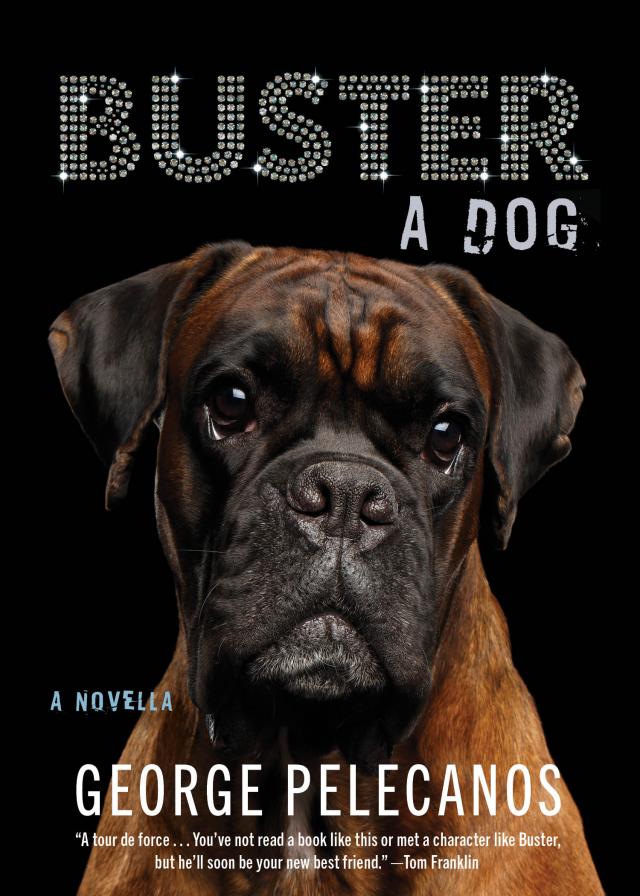
BUSTER
A DOG
GEORGE PELECANOS
This is a work of fiction. All names, characters, places, and incidents are the product of the author’s imagination. Any resemblance to real events or persons, living or dead, is entirely coincidental.
Published by Akashic Books
©2024 George Pelecanos
All rights reserved
ISBN: 978-1-63614-170-1
EISBN: 978-1-63614-171-8
Library of Congress Control Number: 2023949475
First printing
Akashic Books
Brooklyn, New York
Instagram, X/Twitter, Facebook: AkashicBooks
info@akashicbooks.com
www.akashicbooks.com
To Rosa
ONE
MISS DARCIA
If you are like me, the memories of your early days in this world are sometimes vivid, while others are difficult to recall. I remember playing and roughhousing with my brothers and sisters, but I can only bring back one sibling, a girl named Sandy, clearly in my mind. I see a leopard-print squeeze toy, shaped like a bone, which squeaked when I bit into it.
Mostly I remember my mother Kiki, fawn-colored with white markings on her mask and forehead, and her nice smell. The way she’d look at me deep with her brown eyes. My mouth on one of her teats, rough and bumped out, as she gave me her milk. The warmth of her skin as I went to sleep, lying beside her. The steady heartbeat inside her chest.
I did not know my father. Not having a father around wasn’t a problem with me and, as far as I know, it didn’t worry my sister. I can tell you this: as pups, we never felt unloved or alone.
How could we feel lonely, when there were so many of us in so small a space? Besides us animals, there were human children in the apartment where we lived, and a woman, too. This was my first mistress, who went by Darcia to other adults, and Mama to her kids. She kept my mother, me, and my siblings when it might have been easier to take us to the shelter or put us out on the street. I know now that she was poor, because I have seen the other side of life.
It couldn’t have been easy for her. My sister and I had the energy and recklessness that went with youth, and sometimes Miss Darcia would lose her temper with us, especially when she was stressed. Once in a while she would grab me by the nape of my neck, give me a shake, and scold me some. But later she’d be petting me, saying my name real soft. “That’s my Buster,” and, “That’s my good boy,” over and over, until I closed my eyes. She was a kind woman, and she did the best she could.
We all lived together in a place that had two bedrooms, in a building that was one of many buildings that were box-shaped and made out of bricks. A black iron, spear-topped fence surrounded the complex, and the grounds were grass-patched and mostly dirt. Miss Darcia’s oldest son Troy called where we lived “the Eights.” It was shabby, if you want the truth. There were water bugs in the kitchens, rats out by the Dumpsters, and old cars that no longer ran, parked in the l ot. But we didn’t know that a nicer world existed outside that fence. We were comfortable there. We were good.
Everything was fine, until that one day, when a man came to our home in the Eights and took me away. I will talk about him later. But first, some more about those early months of my life, and the apartment complex where we stayed. A place called Capitol Gardens, deep in the southeast part of the city, in Washington, DC.
* * *
Besides Troy, who was a tall, thin young man, there were two other children: Darius, an energetic boy with big ears, and Linda, a happy little girl with a bright smile. Miss Darcia decorated Linda’s braids with seashells and such. As for clothing and sneakers, Linda never went without. The two young ones in one bedroom and Miss Darcia had the other. Troy slept out on a pullout couch. Mostly the kids stayed in the living room, which held a big television set, another sofa, and a long glass table. There were usually cans of soda, bags of chips, candy wrappers, and other stuff on the table. My sister and I liked to get our noses into the bags and tear them up. When we did that, Miss Darcia raised her voice. But I could see a little smile coming up on the side of her mouth, even as she took those bags away.
Troy was in and out of the apartment quite a bit, but when he was there he played video games on the television set, sometimes with Darius. When they were not playing those games, they stared at shows and programs on the screen. I’m saying, the television was always on in that apartment. I didn’t watch it directly because the light hurt my eyes. But listening to the sounds coming from the TV set is partly how I learned human language. And I listened real close to the words spoken by Miss Darcia and her kids.
Above the television set was something like a blanket hung on the wall. It was made of black velvet and there was a picture of a large brown animal, also velvet, stitched upon it. I used to stare at that animal and admire it. It was tall and muscular, and it had hair coming off its head and flowing around its neck. One time, Troy saw me staring, chuckled some, and said, “Buster thinks that’s a big old dog. Guess he never seen a horse.” I had seen horses on the television, a bunch of them in fact, running around a dirt track. I just admired that picture, was all it was.
At first, my world was that living room. My mother had a bed, a green round stuffed thing that was soft and stayed on the floor, right next to the kitchen. I kept my squeeze toy beside the bed. My mother fed us, and as we got older, Miss Darcia took on that task. She poured cool water into a shiny metal bowl that I lapped up with my tongue. Made sure we had dry food in another bowl, and sometimes scraps from the table where the kids ate. I was old enough to chew by then. Kiki had stopped giving me her milk as I got bigger. I guess she was telling me, You are growing up.
By that time, my brothers and sisters had begun to disappear. I don’t know where they went, but I have a vague recollection of Troy handing one of my brothers to a friend of his who was often hanging around. I didn’t like this boy, though he never did me any wrong. He looked plain mean, and he said words that made Miss Darcia frown. Troy told him, “Watch your mouth in front of my mother.” The boy just smiled in his slick way. But anyway, he took my last brother. That left Sandy, me, and my mom. The three of us there, living with Miss Darcia and her kids. This is where my memories begin to get clear.
When the weather was nice, Miss Darcia would take us outside. Our mother would come with us, too. At the back of the apartment building there was a metal pole with metal arms on which Miss Darcia hung wet clothing and bed stuff she had washed. The whole thing could be turned so the clothes and sheets would catch the moving sun. Out there, Sandy and I played tug-of-war with a toy that had mouth handles on both ends of it. My mother watched us and Miss Darcia sat in a white plastic chair. As we played, the two of us growled and laughed at each other with our eyes. If I fell down, I recovered quickly. I was losing that clumsiness I had when I was a young pup.
When someone we didn’t know, kid or adult, walked toward us, my mother would stand and get in front of us until that person passed. Miss Darcia would smile and say, “That’s right, Kiki, you protect your children.” I felt safe out there with my mom.
On those spring days, we would get a rare glimpse of our small community. There were more women than men, and a whole lot of kids. Some of the men who left each morning wore ties. The people who lived around us had skin in shades of brown and almost black. Most were in the middle, color-wise, but some were light and some were dark. When White people came around, which was not often, I noticed that they had different skin tones, too.
In the parking lot, young people gathered around the cars, and you could hear music coming from inside them, drumbeats and a mixture of talking and singing. I recognized this kind of music, since it was what Troy listened to when he was in the apartment.
Some of the young men in the lot owned dogs with thick necks, big heads, and trap-like jaws. I would later come to know these dogs as pit bull terriers. They were not evil but they had been bred and trained to fight, and were naturally equipped to prevail. Pits could be fierce. I would see other dogs lie down on their backs and show their necks to these dogs, which was their way of telling the pit bulls that they would never think to rise up against them. When I saw that, I told myself that I would never act that way to another dog. Even then, I was prideful in that way.
On the grounds of the complex, there was a playground for children, with bars and stuff for them to climb and hang from, but it didn’t get much use, because it was rusty. Miss Darcia warned Darius and Linda not to play on that “broke jungle gym,” and they obeyed. Matter of fact, I never did see any kids using it. Teenagers kind of took that area over, and smoked there at night.
Sometimes, on those outside days, Darius and his young friends would play with us too rough. I had that toy with one of the handles in my mouth once, and Darius grabbed the other end of it and twirled me around. I wasn’t about to let go of it, even as I got dizzy and my neck got to hurting. I was stubborn like that. I must have yelped or something, because Miss Darcia screamed at Darius to stop and the sound made his friends run away. Darius didn’t mean to hurt me, I knew. Like me, he was just a boy, looking to have fun. He must have felt bad, though, ’cause that night he held me in his lap while he watched TV. He smelled like sweat and the sour candy he liked.
Those were happy days. The only time I’d get stressed was when I was hungry. I expected to be fed a certain time each day. Dogs come to feel when feeding time nears. Sometimes Miss Darcia would forget, what with everything else she had going on, so I’d cry and whine. “Don’t be impatient, Buster,” she say. “You know I always fill your dish.” That was true.
Every so often, Miss Darcia would have a visitor over to the apartment, an older man she called James. James came by to fix things, but we could all tell that this was just an excuse for him and Miss Darcia to meet. She would wear nicer clothes and paint her eyes and lips when James was coming around, and sometimes he didn’t do much more than screw in a light bulb on his visits. Miss Darcia was not what I’d call pretty, yet the goodness inside her showed on her face. James could look nice, too. He wore creased slacks and a shirt unbuttoned to show a gold medallion lying flat on his brown chest. There was grease under his fingernails from his job at a place where he worked on cars, but still, he looked good.
I remember this one night when the two of them were at the kitchen table, drinking wine from juice glasses. As the wine in the bottle went down, they laughed easily and their voices grew louder. James smoked cigarettes, and the smoke from his latest hung in the air. I was on my belly, near my mother, who was sprawled out on her green bed. Sandy was chewing on a tennis ball, and Troy and Darius were sitting on the couch, playing a video game. Linda was probably in her bedroom, talking to her dolls.
“This place is getting crowded,” said James. “People and animals alike.”
“I know it,” said Miss Darcia. “It started when Troy brought Kiki home. She was only one dog then.”
“I ain’t know she was pregnant,” said Troy, not turning his head, concentrating on the game on the TV screen.
“Where you get her at?” said James.
“Won her in a dice game,” said Troy. “Boy couldn’t back up his bet. He tried to give me an Authentic jersey he was wearing, but I didn’t want that raggedy old thing. Only thing he had that I did want was his animal.”