To Engineer Is Human

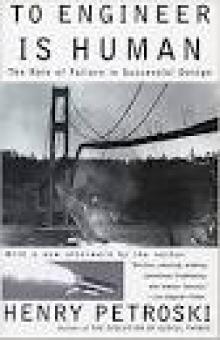
To Engineer Is Human

Henry Petroski

Henry Petroski

"Though ours is an age of high technology, the essence of what engineering is and what engineers do is not common knowledge. Even the most elementary of principles upon which great bridges, jumbo jets, or super computers are built are alien concepts to many. This is so in part because engineering as a human endeavor is not yet integrated into our culture and intellectual tradition. And while educators are currently wrestling with the problem of introducing technology into conventional academic curricula, thus better preparing today's students for life in a world increasingly technological, there is as yet no consensus as to how technological literacy can best be achieved. "I believe, and I argue in this essay, that the ideas of engineering are in fact in our bones and part of our human nature and experience. Furthermore, I believe that an understanding and an appreciation of engineers and engineering can be gotten without an engineering or technical education. Thus I...
Read online
  • 625
The Book on the Bookshelf

The Book on the Bookshelf

Henry Petroski

Henry Petroski

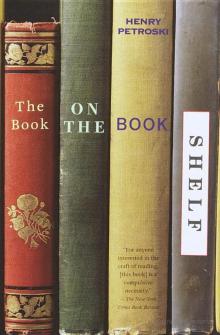
From the author of the highly praised The Pencil and The Evolution of Useful Things comes another captivating history of the seemingly mundane: the book and its storage.Most of us take for granted that our books are vertical on our shelves with the spines facing out, but Henry Petroski, inveterately curious engineer, didn't.  As a result, readers are guided along the astonishing evolution from papyrus scrolls boxed at Alexandria to upright books shelved at the Library of Congress. Unimpeachably researched, enviably written, and charmed with anecdotes from Seneca to Samuel Pepys to a nineteenth-century bibliophile who had to climb over his books to get into bed, The Book on the Bookshelf is indispensable for anyone who loves books.From the Trade Paperback edition.Amazon.com ReviewConsider the book. Though Goodnight Moon and Finnegans Wake differ considerably in content and intended audience, they do share some basic characteristics. They have pages, they're roughly the same shape, and whether in a bookstore, library, or private home, they are generally stored vertically on shelves. Indeed, this is so much the norm that in these days of high-tech printing presses and chain bookstores, it's easy to believe that the book, like the cockroach, remains much the same as it ever was. But as Henry Petroski makes abundantly clear in Book on the Bookshelf, books as we know them have had a long and complex evolution. Indeed, he takes us from the scroll to the codex to the hand-lettered illuminated texts that were so rare and valuable they were chained to lecterns to prevent theft. Along the way he provides plenty of amusing anecdotes about libraries (according to one possibly apocryphal account, the library at Alexandria borrowed the works of the great Greek authors from Athens, had them copied, and then sent the copies back, keeping the originals), book collectors, and the care of books. Book-lover though he may be, however, Henry Petroski is, first and foremost, an engineer and so, in the end, it is the evolution of bookshelves even more than of books that fascinates him. Pigeonholes for scrolls, book presses containing thousands of chained volumes, rotating lecterns that allowed scholars to peruse more than one book at a time--these are just a few of the ingenious methods readers have devised over the centuries for storing their books: "in cabinets beneath the desks, on shelves in front of them, in triangular attic-like spaces formed under the back-to-back sloped surfaces of desktops or small tabletop lecterns that rested upon a horizontal surface." Placing books vertically on shelves, spines facing outward, is a fairly recent invention, it would seem. Well written as it is, if Book on the Bookshelf were only about books-as-furniture, it would have little appeal to the general reader. Petroski, however, uses this treatise on design to examine the very human motivations that lie behind it. From the example of Samuel Pepys, who refused to have more titles than his library could hold (about 3,000), to an appendix detailing all the ways people organize their collections (by sentimental value, by size, by color, and by price, to name a few of the more unconventional methods), Petroski peppers his account with enough human interest to keep his audience reading from cover to cover. --Alix WilberFrom Publishers WeeklyThat bookshelves might harbor secret and enchanting lives is a thrilling prospect for any serious reader. What laws of human nature govern our sturdy cases of books? What damning quirks of character glare from a few casually stowed volumes? In this disappointing study, however, Petroski's effort to reveal the "evolution of the bookshelf as we know it" yields few rewards. Pondering the physics of the bookend and the genealogy of the library carrel, this Duke University scholar observes the bookshelf as a piece of the infrastructure undergirding our civilization. We learn that medieval books were chained to their shelves to prevent theft, and that beverage stains have plagued bibliophiles almost since the dawn of the printed word. Admirers of Petroski's earlier works (The Evolution of Useful Things, Remaking the World, etc.) will not be surprised by his exquisite research, or by the gusto with which he plunges into the dustiest of library bins. But the bookshelf proves a more oblique topic than bridges or even pencils, two of Petroski's other interests. The practical construction principles of bookshelves make for rather dull reading, and conjecture about lectern usage in the Middle Ages wears thin. This book is most successful when delving into the gritty aspects of engineering, whether it be the cantilevered forces of library book stacks or the architecture of the British Museum Reading Room. After lingering among such fusty stacks, readers will welcome the whimsical appendix, which proposes arranging one's books alphabetically by the author's first name, or even by the first word of the antepenultimate sentence. (Sept.) Copyright 1999 Reed Business Information, Inc.
Read online
  • 70
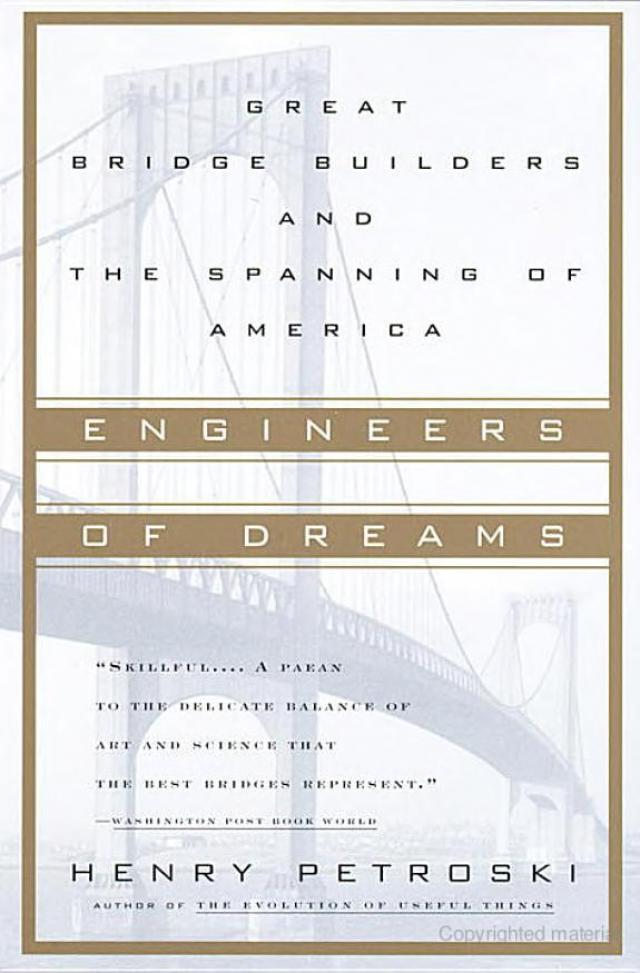
Engineers of Dreams: Great Bridge Builders and the Spanning of America

Engineers of Dreams: Great Bridge Builders and the Spanning of America

Henry Petroski

Henry Petroski

Petroski reveals the science and engineering--not to mention the politics, egotism, and sheer magic--behind America's great bridges, particularly those constructed during the great bridge-building era starting in the 1870s and continuing through the 1930s.It is the story of the men and women who built the St. Louis, the George Washington, and the Golden Gate bridges, drawing not only on their mastery of numbers but on their gifts for persuasion and self-promotion.It is an account of triumphs and ignominious disasters (including the Tacoma Narrows Bridge, which literally twisted itself apart in a high wind). And throughout this grandly engaging book, Petroski lets us see how bridges became the "symbols and souls" of our civilization, as well as testaments to their builders' vision, ingenuity, and perseverance."Seamlessly linked...With astonishing scope and generosity of view, Mr. Petroski places the tradition of American bridge-building in perspective."--New York Times Book ReviewFrom the Trade Paperback edition.Amazon.com ReviewHenry Petroski's lyrical history of bridge builders in America is organized around five engineers: James Eads (inventor of the diving bell, which bridged Mississippi at St. Louis); Theodore Cooper (railroad bridge engineer and designer of the ill-fated Quebec Bridge); Gustav Lindenthal (Hell Gate Bridge, New York); Othmar Ammann (George Washington and Verrazano-Narrow bridges); and David Steinman (Mackinac bridge). Petroski's opening and closing chapters, "Imagine" and "Realize," remind us how a bridge starts out as a dream of engineering, but ends as a reality of compromise and maintenance. Edward Tenner says that "The profound contribution of Engineers of Dreams is to remind us that communication across generations may be the most important bridge of all." From Publishers WeeklyFocusing on five engineers and their creations, Petroski looks at the great bridge-building era that spanned from the 1870s to the 1930s. Copyright 1996 Reed Business Information, Inc.
Read online
  • 61
The Pencil: A History of Design and Circumstance

The Pencil: A History of Design and Circumstance

Henry Petroski

Henry Petroski

Henry Petroski traces the origins of the pencil back to ancient Greece and Rome, writes factually and charmingly about its development over the centuries and around the world, and shows what the pencil can teach us about engineering and technology today.From the Trade Paperback edition.Amazon.com ReviewLike most other human artifacts, the common pencil, made and sold today by the millions, has a long and complex history. Henry Petroski, who combines a talent for fine writing with a deep knowledge of engineering and technological history, examines the story of the pencil, considering it not only as a thing in itself, but also as an exemplar of all things that are designed and manufactured.Petroski ranges widely in time, discussing the writing technologies of antiquity. But his story really begins in the early modern period, when, in 1565, a Swiss naturalist first described the properties of the mineral that became known as graphite. Petroski traces the evolution of the pencil through the Industrial Revolution, when machine manufacture replaced earlier handwork. Along the way, he looks at some of pencil making's great innovators--including Henry David Thoreau, the famed writer, who worked in his father's pencil factory, inventing techniques for grinding graphite and experimenting with blends of lead, clay, and other ingredients to yield pencils of varying hardness and darkness. Petroski closes with a look at how pencils are made today--a still-imperfect technology that may yet evolve with new advances in materials and design. --Gregory McNameeFrom Publishers WeeklyIn this age of the computer, Petroski's delightful, elegant history of the lowly pencil is a mind-sharpener, a revelation. The pencil's slow evolution from metallic-lead stylus paralleled the growth of engineering prior to the Industrial Revolution. In America, the saga of pencil-making encompassed gentlemanly cabinetmaker Ebenezer Wood and philosopher/amateur engineer Henry David Thoreau; the latter, while working in his father's pencil business, hit upon the idea of combining graphite and clay. In modern times, pencil-making was transformed from cottage industry to mechanized science, with a boost from international trade rivalries, the Faber manufacturing family of Germany and engineers' quests for perfection. Toulouse-Lautrec said, "I am a pencil." John Steinbeck was seemingly obsessed with his pencils' points, shapes and sizes. Petroski ( To Engineer Is Human ) illuminates the intersection of engineering, history, economics and culture. Illustrated. Copyright 1989 Reed Business Information, Inc.
Read online

  • 48
183